Create
Generate, design, develop, construct, or propose something new from what has been learned.
History: Build an interpretation, argument, exhibit, model, or product that demonstrates historical reasoning.
Interactive Pyramid

Generate, design, develop, construct, or propose something new from what has been learned.
History: Build an interpretation, argument, exhibit, model, or product that demonstrates historical reasoning.
Make a judgment using evidence, criteria, and reasoning.
History: Decide which cause, interpretation, source, or outcome is best supported and defend the judgment.
Examine relationships, patterns, causes, parts, and perspectives.
History: Trace connections among causes, evidence, events, perspectives, and consequences.
Use knowledge or a concept in a new situation.
Social Studies: Use a civic, economic, geographic, or historical concept to interpret a new case.
Explain ideas, meaning, relationships, and concepts in your own words.
Social Studies: Explain how an institution, process, development, or concept works and why it matters.
Retrieve relevant facts, terms, people, places, dates, concepts, and definitions.
History: Establish the factual knowledge students need before asking them to reason with it.

Receive the Bloom's Taxonomy teacher companion and classroom-ready files free from this page. $5 resource value.
Bloom's Taxonomy gives educators a shared way to describe the kind of thinking a learning task requires. In social studies, it helps teachers move deliberately from retrieving essential knowledge to explaining, applying, analyzing, evaluating, and creating with evidence.
Use the taxonomy to align the learning goal, the question or task, the evidence students use, and the response students must produce.
The pyramid is not a rule that every lesson must climb all six levels. Remembering and understanding are valuable when they provide the knowledge students need for deeper reasoning.
Rigor comes from what students do with content and evidence—not from attaching a “higher-level” verb to an otherwise shallow task.
The original cognitive taxonomy used the categories Knowledge, Comprehension, Application, Analysis, Synthesis, and Evaluation.
The revised taxonomy reframed the categories as action-oriented processes: Remember, Understand, Apply, Analyze, Evaluate, and Create.
Educators continue to use Bloom's as a planning lens for learning outcomes, questioning, assessment, and instructional design.
Authoritative references: Cornell University Center for Teaching Innovation · Anderson, L. W., & Krathwohl, D. R. (Eds.). A Taxonomy for Learning, Teaching, and Assessing (2001).
The question is not “How high can I push the verb?” The better question is: What kind of thinking should students demonstrate here, and what evidence will show that they can do it?
Enter a topic, choose a social-studies lens, and select the kind of thinking you want students to demonstrate. The tool creates adaptable question stems—no account, API, or student data required.
These companion resources extend the same historical-thinking approach into classroom visuals, source analysis, discussion, and complete visual-history instruction.
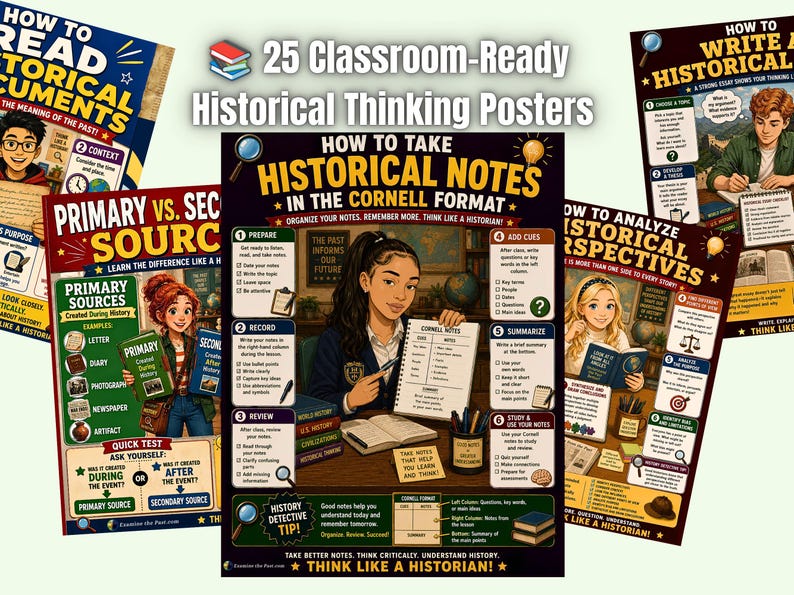
25 classroom-ready posters plus 5 advanced bonus posters focused on evidence, sources, maps, argumentation, note-taking, propaganda, debate, and more.
View on Etsy >
A Grades 6–12 visual-history lesson combining PowerPoint instruction, teacher guidance, evidence analysis, formative checks, and a bonus digital historical investigation.
View on Etsy >Product descriptions summarized from the Examine the Past Etsy listings. Product availability, pricing, and promotions may change on Etsy.